The five-minute study is real. It measured whether they picked up the phone.

Systems Ninjas (2026). Provenance trace of the five-minute lead-response claim and its family. Primary documents fetched and read 2026-09-01. systemsninjas.com/post/five-minute-lead-response-rule
Take any of it. You do not need to ask. If you find an error in here we would rather hear about it than not, and the correction goes on the page.
There is a real study, and the famous number is in it. What is not in it is the claim almost everyone attaches to the number, which is that answering in five minutes makes people buy from you.
The study measured whether you got them on the phone. It says so, in its own words, and then it says something else that nobody repeats.
01 / The documentWhat the document actually is
How Much Time Do You Have Before Web-Generated Leads Go Cold?, copyright 2007, published by a sales-software company and presented by that company's CEO alongside an academic at a marketing conference in October 2007.
The dataset is genuine and reasonably large: three years, more than 15,000 leads, more than 100,000 call attempts. It was drawn from the vendor's own customers, running on the vendor's own system.
The line everyone quotes, verbatim:
"The odds of qualifying a lead if called in 5 minutes versus 30 minutes drop 21 times."
That sentence is accurate. Here is what sits around it.
02 / Its own caveatsThe four caveats the study states about itself
1. It did not measure sales. The document says, in plain text: "This study did not address close ratios." The 21x is about QUALIFICATION, meaning you reached a human and established they were a real prospect. It is not about revenue. Every time you see "21 times more likely to convert", the word has been quietly swapped.
2. Half the research failed. The study had a second component, a survey of 495 companies. The authors report that they "couldn't find ANY statistically significant answers" from it. It is routinely cited as though both halves worked.
3. The effect is invisible in any single business. The document states the pattern appears "only when data from several companies is combined". So the finding is real at the level of a six-company pool, and the promise implied to a single business owner ... that this will show up in YOUR numbers ... is not what was measured.
4. The publisher sold the remedy. Again from the document: "This study caused a significant shift in our corporate positioning." That does not make the data false. It does mean this is a vendor white paper, not independent research, and it should be introduced that way.
03 / Two wrong labelsTwo labels that are simply wrong
It is not MIT research. The academic co-presenter held a Faculty Fellow position at MIT Sloan. A university affiliation on a co-author is not a university study, and the paper was never peer-reviewed.
It is not Harvard Business Review. HBR published a different piece of research, with different numbers, and the two have been welded together in a thousand blog posts. If a page cites "Harvard" for the 5-minute and 21x figures, that page has not read either source.
04 / The family, tracedThe other numbers in this family, traced
We tried to find the primary source for each of these. Here is where each one ends up.
| Claim | Where the trail ends |
|---|---|
| "78% buy from the company that responds first" | Attributed to a survey with no retrievable report, sample, method or date |
| "35 to 50% of sales go to the first responder" | Appears in no primary document from the company it is attributed to |
| "The average business takes 42 hours to respond" | Real, but it is a long-tail mean that describes almost nobody. See below |
Absence of a primary is not proof a claim is false. It does mean you should not put it in a proposal, and it means anyone who does has not checked.
05 / The one to citeThe study that is worth citing, and the honest way to cite it
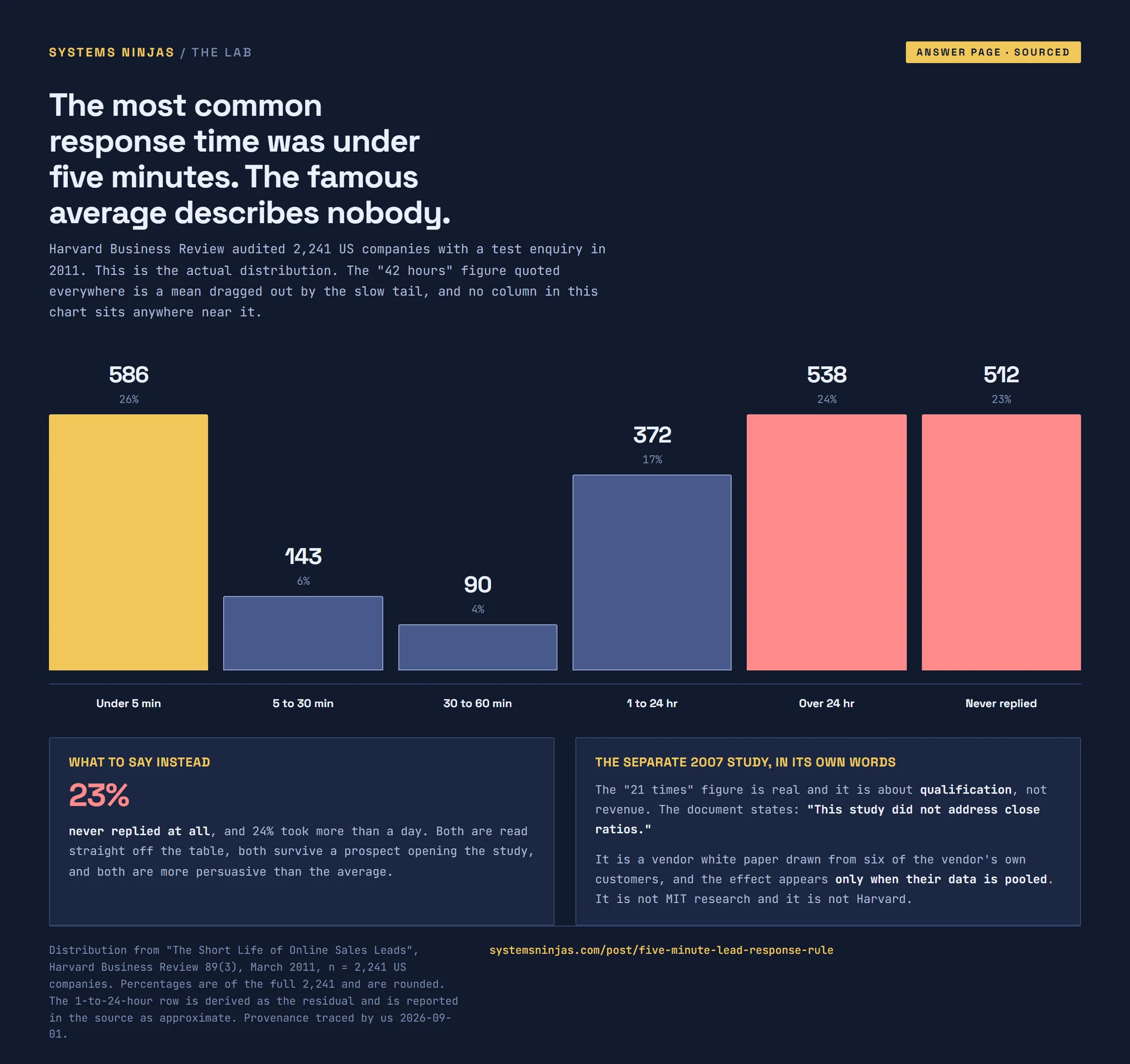
Harvard Business Review, March 2011, The Short Life of Online Sales Leads. 2,241 US companies audited with a test enquiry. This one is real, retrievable and specific.
| Response time | Companies |
|---|---|
| Under 5 minutes | 586 (26%) |
| 5 to 30 minutes | 143 |
| 30 to 60 minutes | 90 |
| 1 to 24 hours | ~372 |
| More than 24 hours | 538 |
| Never replied at all | 512 (23%) |
Look at the top row before you quote the famous one. The single most common behaviour in that dataset was answering in under five minutes. The "42 hours" average that gets quoted everywhere is produced by a slow minority dragging the mean, and it describes a typical company that does not exist in the data.
Quoting the mean is not merely weak. It is WRONG, and a sharp prospect who opens the study can see it in one glance.
The honest version of the same data is more persuasive anyway: 23% never replied at all, and 24% took more than a day. Both true, both from the table, and both survive being checked.
The study is also fifteen years old and entirely American, which is the reason we run our own measurements on this market rather than importing that one.
06 / So what is it worthSo what is speed actually worth?
Here is the position we will defend:
Speed does not close deals. It decides whether you get to have the conversation at all.
That claim needs no disputed statistic. It is what the 2007 study measured (contact and qualification, not revenue), it is consistent with the 2011 audit (a quarter of enquiries were never answered by anyone), and it is the version that survives a prospect looking it up.
It also has a practical consequence that a "respond in 5 minutes" slogan hides: if your problem is that 23% of enquiries get no reply ever, shaving thirty minutes off your average response time fixes nothing. Those are different failures with different repairs.
07 / Our unproven beliefThe part where fast is not better, which we cannot yet prove
One thing we believe and have not measured, flagged as such.
Reply latency expectations are set by the CHANNEL, not by the business. On a live-chat widget, an instant answer reads as an agent at a desk. On WhatsApp, an instant answer to a complicated question reads as a machine, because no human types five considered paragraphs in eight seconds.
So the same latency can be a defect at one end and a tell at the other. We think a considered reply that takes half a minute outperforms an instant shallow one on messaging channels, and we have said so to a client in writing along with a commitment to reverse it if the abandonment data disagrees.
That is a belief with a test attached, not a finding. We are not going to dress it up as one. When we have the numbers off our own traffic, they will be published here whichever way they land.
08 / The question to askThe one question worth asking anyone selling you speed
Ask where the number came from, and then ask what it measured.
Most of the response-time statistics in circulation trace to a single vendor document from 2007, usually via a chain of blog posts that each cite the previous one. It is a fair question to put to anyone quoting it, including us.
Primary documents fetched and read 2026-09-01. Full provenance chain for these and eleven other industry statistics is maintained internally and summarised in our public claims policy: nothing goes on a client's page unless we can hand them the source.
Send us a statistic and we will trace it for you
Pick any number off an agency's landing page, including ours, and send it over. We will look for the primary document and tell you what we find, including when the honest answer is that the trail dies at a blog post with no sample size attached. It costs you nothing, and it is the fastest way to grade whoever is pitching you.
Trace a statistic [email protected] · No client of ours is named anywhere on this page, and if you become one, you will not be either.
Uldis Zalcmanis aka Systems Rockstar
Founder, Systems Ninjas · Kuala Lumpur
I build the automation and AI systems businesses actually run on, and I am the person who gets called when one of them quietly stops working. Born in Riga, based in Malaysia, father of two, and constitutionally unable to stop reading page source.
The Lab is where the measurements get published, including the ones that do not flatter us.